

Business Operation · 2025
In this section23 topics
- Corporate Information4 items
- Dividend Policy2 items
- Major Shareholders1 item
- Business Strategies Overview6 items
- Material Changes & Developments1 item
- Use of Proceeds from Securities Offerings1 item
- Commitments Made in the Registration Statement1 item
- Group Operating-Structure Policy1 item
- Companies Where the Company Holds ≥10%1 item
- Shareholders with Potential Conflict of Interest1 item
- Relationships Among Major Shareholders2 items
- Shareholders' Agreement1 item
- Shareholding Diagram (Group Structure)3 items
- Income Structure4 items
- Product / Service Characteristics2 items
- Research & Development2 items
- Assets Used in the Business4 items
- Marketing Policy & Competition2 items
- Procurement of Products & Services6 items
- Product Information — Overview1 item
- Projects Under Construction8 items
- Debentures & Bills of Exchange3 items
- Convertible Securities2 items
Corporate Information
Company Name
BCPG PUBLIC COMPANY LIMITED
Telephone
0-2335-8999
Website
www.bcpggroup.com
ir@bcpggroup.com
Dividend Policy
Dividend Policy
The Company has a policy to pay dividends to shareholders of not less than 40.00% of net profit based on the separate financial statements, after deduction of all types of reserves as required by the Company’s Articles of Association and applicable laws. A resolution of the Board of Directors approving dividend payment shall be proposed to the shareholders’ meeting for approval, except for interim dividends, for which the Board of Directors has the authority to approve. The Board shall report such interim dividend payment to the shareholders’ meeting for acknowledgement at the next meeting. Dividend payments depend on economic conditions, the Company’s cash flow, and the investment plans of the Company and its affiliates in each year, as well as other considerations that the Board of Directors deems necessary and appropriate.
Historical Dividend Payments
| This Year | Last Year | 2 Years Ago | 3 Years Ago | 4 Years Ago | Metric | Description |
|---|---|---|---|---|---|---|
| 0.29 | 0.61 | 0.38 | 0.91 | 0.76 | Net profit per share (Baht : Share) | Net profit per share (baht : share) |
| 0.35 | 0.28 | 0.25 | 0.36 | 0.33 | Dividend per share (Baht : Share) | Dividend per share (baht : share) |
| 0 | 0 | 0 | 0 | 0 | Dividend stock ratio (Number of original shares: dividend shares) | Ratio of stock dividend payment (existing share : stock dividend) |
| 0 | 0 | 0 | 0 | 0 | Dividend share value per share (Baht : Share) | Value of stock dividend per share (baht : share) |
| 0.35 | 0.28 | 0.25 | 0.36 | 0.33 | Total dividend payment value (Baht : Share) | Total dividend payment (baht : share) |
| 128.11 | 48.35 | 70.59 | 41.56 | 47.49 | Dividend payout ratio to net profit (%) | Dividend payout ratio compared to net profit (%) |
| 0.1 | 0.1 | 0.1 | 0.2 | 0.16 | xx | |
| 0.25 | 0.18 | 0.15 | 0.16 | 0.17 | xx |
Business Strategies Overview
Chairman's Message
Dear Shareholders,
The year 2025 was another year in which BCPG continued to move forward steadily amid a rapidly changing global landscape, encompassing economic conditions, energy developments, and rising societal expectations toward the role of businesses. For us, true growth is not merely business expansion, but growth founded on transparency, accountability, and good corporate governance.
Over the years, BCPG has focused on building a strong organization from within while continuously developing its clean energy businesses. We firmly believe that prudent decision-making, clarity in execution, and due consideration for all stakeholders are the driving forces that sustain confidence and long-term sustainability.
Opening a New Decade toward Broader Growth
The Company has announced its strategic plan, “The Next Decade: Broadening Horizons of Sustainability,” to advance into a new decade of growth by leveraging its expertise in clean energy toward the development of infrastructure that supports a green economy in the digital era.
Our objectives are clear: to achieve quality growth while elevating corporate standards to the international level, including aspiring to be listed in the SET50 Index and to be included in the global sustainability index, DJSI. These goals reflect our commitment to balancing business returns with long-term value creation for society.
A Strong Portfolio Supporting the Global Energy Transition
BCPG has built a resilient and well-balanced clean energy investment portfolio, diversified across multiple regions under long-term power purchase agreements with both public and private sector counterparties. This structure provides stable income streams and mitigates market volatility.
In the past year, key projects included four natural gas power plants in the United States operating within the PJM market, which continued to receive higher capacity payments and secured contracted revenues through 2028. In parallel, the Monsoon wind power project, with a total capacity of 600 MW, officially commenced commercial operation. This project represents one of the largest wind power developments in ASEAN and marks a significant milestone in regional clean energy interconnection from the Lao PDR to Viet Nam.
At the same time, the Company continued to expand investments in Taiwan and to develop rooftop solar projects in Thailand, reflecting our capability to efficiently manage energy assets across diverse operating contexts.
The strength of our business and revenue structure was reaffirmed by TRIS Rating, which maintained the Company’s corporate and debenture credit ratings at “A” with a “Stable” outlook, reflecting market confidence in our capabilities and financial stability.
Energy that Connects Communities, the Economy, and Our World
BCPG believes that clean energy forms the foundation of sustainable development. Accordingly, we integrate clean energy solutions with community-based economic development, helping to reduce operating costs, enhance energy security, and support a low-carbon society for cooperatives under the climate action network.
We also play an active role in advancing the regional carbon market as a founding member of the Carbon Markets Club (CMC), now entering its fifth year of operation. The CMC supports carbon credit management and trading in Thailand and helps prepare the private sector for international environmental measures such as CBAM. It serves as a platform for knowledge-sharing, collaboration, and the development of a carbon ecosystem for Thai businesses, using carbon markets as an economic mechanism toward Net Zero. Currently, the CMC has more than 1,700 members from both organizations and individuals and has expanded regional cooperation through the ASEAN Common Carbon Framework (ACCF) to strengthen ASEAN’s collective position on the global stage.
Alongside these efforts, we continue to foster environmental awareness through learning-based activities with youth, including the “Mangrove Mud Hands” program, sea turtle release initiatives, and activities promoting the circular economy, encouraging responsible resource use and tangible participation in environmental conservation.
Strong Governance as the Foundation of a Sustainable Organization
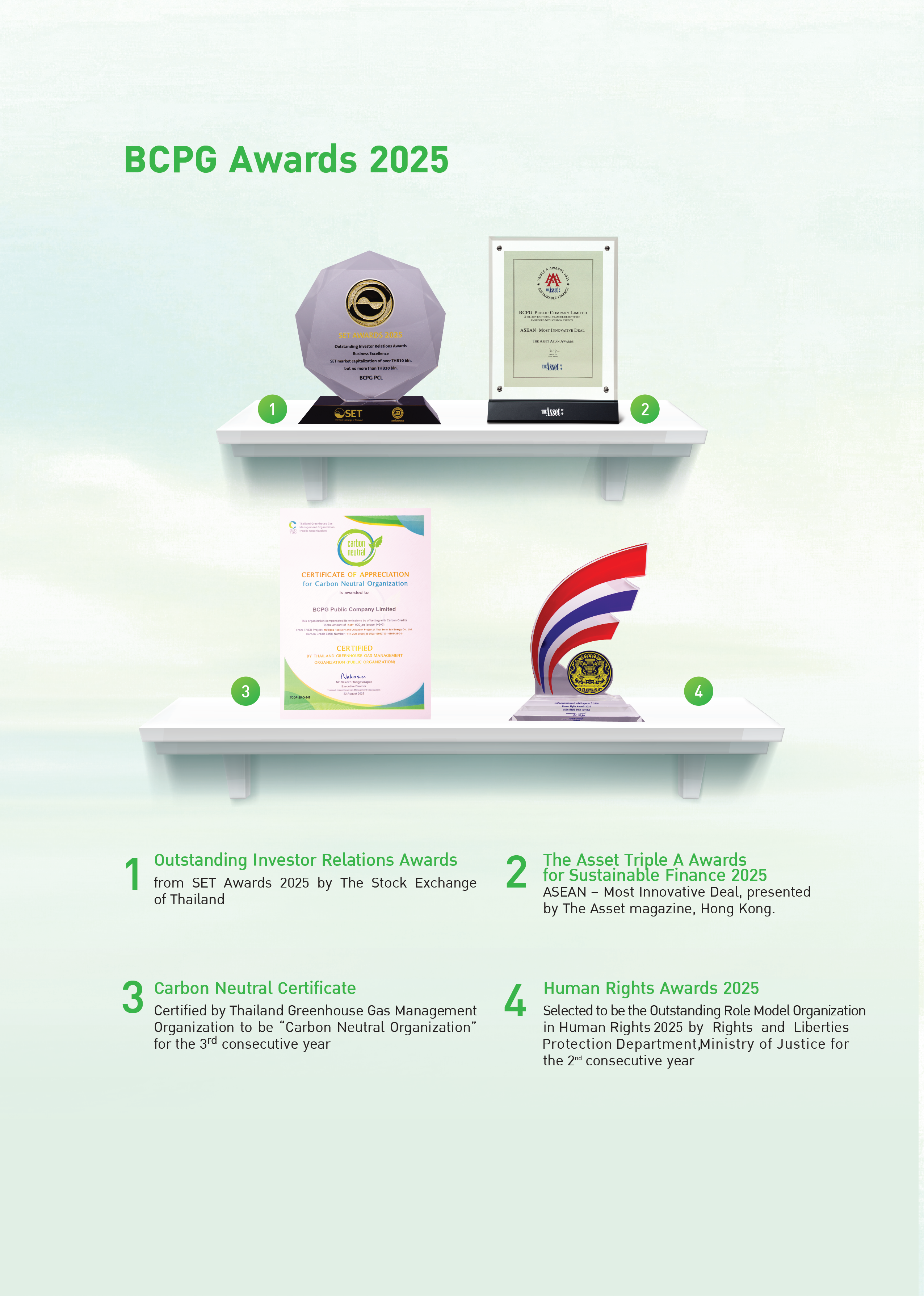
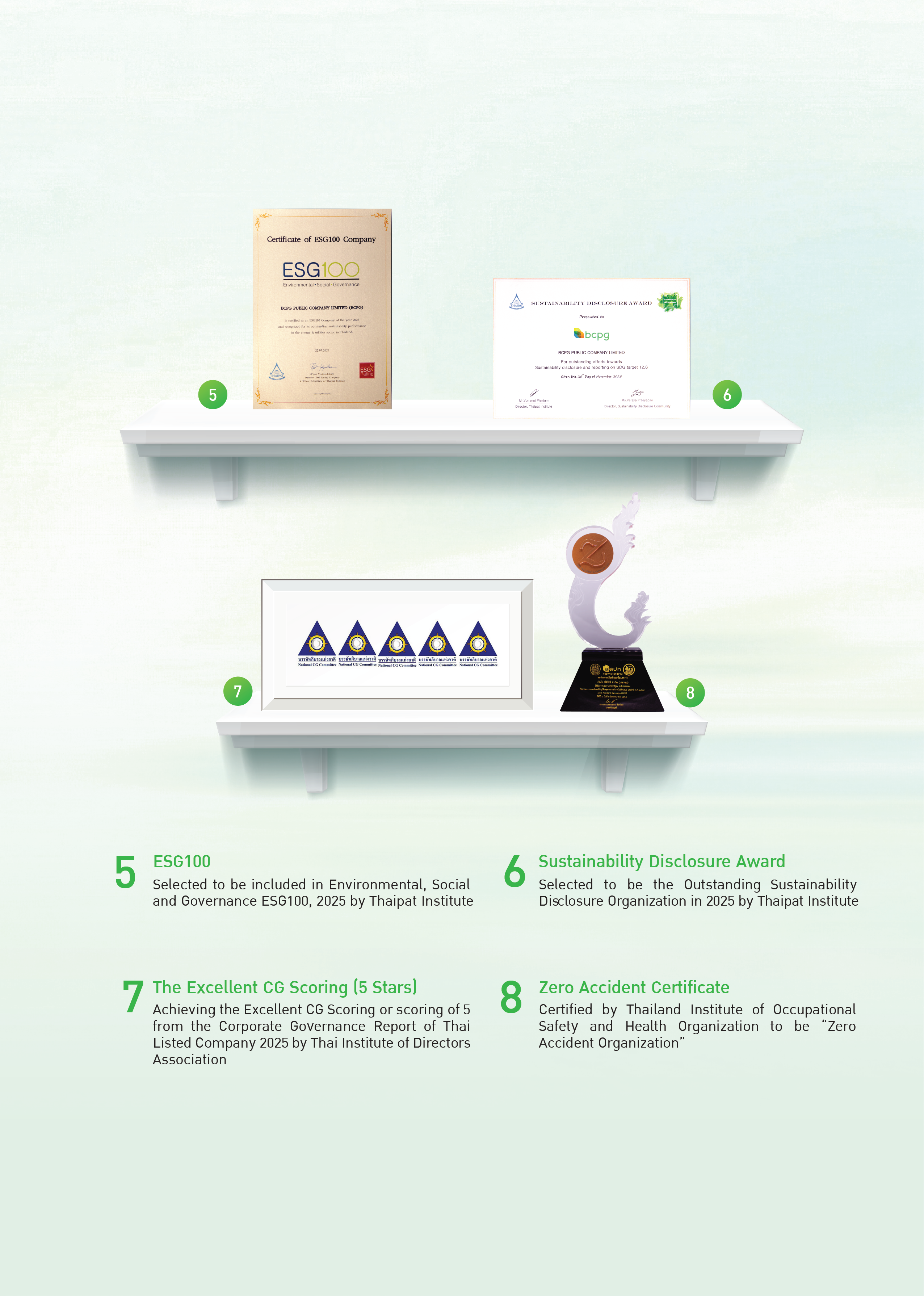
The Company adheres firmly to the principles of good corporate governance, transparency, comprehensive risk management, and ethical business conduct. The Company has been selected as one of the ESG 100 companies for the eighth consecutive year and has continuously received
Outstanding Role Model Organization Award for Human Rights reflecting its steadfast commitment to conducting business with due regard to environmental, social, and governance (ESG) principles.
On behalf of the Board of Directors, I would like to express my sincere appreciation to our shareholders, executives, employees, business partners, and all stakeholders for their continued trust and support. The Company will continue to conduct its business with prudence under a strong governance framework, with a strong commitment to achieving balanced growth and delivering sustainable value to society and the environment.
Thank you
Mr. Prasong Poontaneat
Chairman
Vision
At BCPG, we are committed to creating a sustainable green world.
Objectives
We actively drive the transition to sustainable and reliable clean energy through innovative solutions for all.
Goals
At BCPG, we are committed to continuously creating value for our shareholders by investing in high-quality projects and upholding strict financial discipline to drive sustainable, long-term growth. Our business is built on a foundation of responsibility—embracing social and environmental stewardship and adhering to the highest standards of corporate governance. We are committed to earning the trust of investors and the capital market, with clear goals to achieve carbon neutrality by 2030 and reach net zero greenhouse gas emissions by 2050 in a measurable and meaningful way.
Business Strategies
Business Diversification
Capital Efficiency
Sustainability
Other Information
| Name | Description |
|---|---|
| BCPG Awards 2025 |
|
Material Changes & Developments
Material Changes & Developments
| Year | Description |
|---|---|
| 2,023 |
|
| 2,024 |
|
| 2,025 |
|
Use of Proceeds from Securities Offerings
Is There Money Raised from a Securities Offering Still to Report On?
No
Commitments Made in the Registration Statement
Are There Commitments or Conditions from an Offering or Listing?
No
Group Operating-Structure Policy
Description
The Group’s core business is the generation of electricity from clean energy for sale to government and private sector customers. The business initially commenced with solar power plants in Thailand and subsequently expanded to clean energy power plants overseas, including wind power plants in the Philippines; hydropower and wind power plants in the Lao PDR; solar power plants in Taiwan; and combined cycle power plants in the United States. As of the end of 2025, the Group had power plants with a total contracted capacity of [1,725.3] megawatts. In addition, the Company has invested in the business of electricity distribution generated from rooftop solar systems installed on buildings or other areas, such as residential houses, factories, buildings, or other structures/areas, and may also include the installation of battery energy storage systems. Such operations are conducted by the Company and through Thai Digital Energy Development Co., Ltd. (“TDED”).
Apart from the electricity generation business, the Group also operates infrastructure businesses with the potential to generate recurring income, namely: (1) an oil storage terminal project comprising oil storage tanks, oil pipelines, and onshore oil distribution facilities, together with port facilities for vessels of 30,000 Gross Tonnage (GT) and 120,000 Gross Tonnage (GT), located in Phetchaburi Province; and (2) a district cooling management project with a production capacity of 18,000 refrigeration tons, serving the Suan Luang–Sam Yan commercial district.
Companies Where the Company Holds ≥10%
Companies (≥10% Holding)
| Company Name | Address | Telephone | Business Type | Security Type | Shares | Paid-up Shares |
|---|---|---|---|---|---|---|
| BANGCHAK SOLAR ENERGY COMPANY LIMITED ("BSE") | 99/1 Moo 9, Bang Krasan Sub-district, Bang Pa-In District, Phra Nakhon Si Ayutthaya | - | Solar Power Plant | Common shares | 17,999,998 | 18,000,000 |
| BANGCHAK SOLAR ENERGY (BURIRAM) COMPANY LIMITED ("BRM") | 99/1 Moo 9, Bang Krasan Sub-district, Bang Pa-In District, Phra Nakhon Si Ayutthaya | - | Solar Power Plant | Common shares | 7,549,998 | 7,550,000 |
| BANGCHAK SOLAR ENERGY (BURIRAM1) COMPANY LIMITED ("BRM1") | 99/1 Moo 9, Bang Krasan Sub-district, Bang Pa-In District, Phra Nakhon Si Ayutthaya | - | Solar Power Plant | Common shares | 7,649,998 | 7,650,000 |
| BANGCHAK SOLAR ENERGY (NAKHONRATCHASIMA) COMPANY LIMITED ("NMA") | 99/1 Moo 9, Bang Krasan Sub-district, Bang Pa-In District, Phra Nakhon Si Ayutthaya | - | Solar Power Plant | Common shares | 7,599,998 | 7,600,000 |
| BANGCHAK SOLAR ENERGY (CHAIYAPHUM1) CO., LTD. ("CPM1") | 99/1 Moo 9, Bang Krasan Sub-district, Bang Pa-In District, Phra Nakhon Si Ayutthaya | - | Solar Power Plant | Common shares | 7,799,998 | 7,800,000 |
| BANGCHAK SOLAR ENERGY (PRACHINBURI) COMPANY LIMITED ("PRI") | 99/1 Moo 9, Bang Krasan Sub-district, Bang Pa-In District, Phra Nakhon Si Ayutthaya | - | Solar Power Plant | Common shares | 13,999,998 | 14,000,000 |
| BCPG WIND (LIGOR) COMPANY LIMITED ("LLG") | 22/2 Moo 2, Tha Phaya Sub-district, Pak Phanang District, Nakhon Si Thammarat | - | Wind Power Plant | Common shares | 2,499,998 | 2,500,000 |
| BCPG INDOCHINA COMPANY LIMITED ("BIC") | 99/1 Moo 9, Bang Krasan Sub-district, Bang Pa-In District, Phra Nakhon Si Ayutthaya | - | Investment in Other Companies | Common shares | 43,509,998 | 43,510,000 |
| BSE POWER HOLDINGS (THAILAND) COMPANY LIMITED ("BSPH") | 99/1 Moo 9, Bang Krasan Sub-district, Bang Pa-In District, Phra Nakhon Si Ayutthaya | - | Investment in Other Companies | Common shares | 9,997 | 10,000 |
| BSE POWER (KANJANABURI) COMPANY LIMITED ("BSP-KAN") | 99/1 Moo 9, Bang Krasan Sub-district, Bang Pa-In District, Phra Nakhon Si Ayutthaya | - | Solar Power Plant | Common shares | 5,869,998 | 5,870,000 |
| BSE POWER (KANJANABURI 1) COMPANY LIMITED ("BSP-KAN1") | 99/1 Moo 9, Bang Krasan Sub-district, Bang Pa-In District, Phra Nakhon Si Ayutthaya | - | Solar Power Plant | Common shares | 1,249,998 | 1,250,000 |
| BSE POWER COMPANY LIMITED ("BSP") | 99/1 Moo 9, Bang Krasan Sub-district, Bang Pa-In District, Phra Nakhon Si Ayutthaya | - | Investment in Other Companies | Common shares | 19,999,998 | 20,000,000 |
| BSE POWER (LOPBURI) COMPANY LIMITED ("BSP-LOP") | 99/1 Moo 9, Bang Krasan Sub-district, Bang Pa-In District, Phra Nakhon Si Ayutthaya | - | Solar Power Plant | Common shares | 1,399,998 | 1,400,000 |
| BSE POWER (PRACHINBURI) COMPANY LIMITED ("BSP-CPRS") | 99/1 Moo 9, Bang Krasan Sub-district, Bang Pa-In District, Phra Nakhon Si Ayutthaya | - | Solar Power Plant | Common shares | 6,199,998 | 6,200,000 |
| BSE POWER (PETCHNAKORN) CO., LTD. ("BSP-PNK") | 99/1 Moo 9, Bang Krasan Sub-district, Bang Pa-In District, Phra Nakhon Si Ayutthaya | - | Solar Power Plant | Common shares | 353,999 | 354,000 |
| BSE POWER (UDONTHANI) CO., LTD. ("BSP-UTH") | 99/1 Moo 9, Bang Krasan Sub-district, Bang Pa-In District, Phra Nakhon Si Ayutthaya | - | Solar Power Plant | Common shares | 629,999 | 630,000 |
| BCPG ENERGY LOGISTICS COMPANY LIMITED ("BCPGEL") | 2098 M Tower Building, 15th Floor, Sukhumvit Road, Phra Khanong Tai Sub-district, Phra Khanong District, Bangkok | - | Investment in Other Companies | Common shares | 9,998 | 10,000 |
| ASIA LINK TERMINAL CO., LTD. ("ALT") | 88/2 Moo 5, Bang Kaew Sub-district, Ban Laem District, Phetchaburi | - | Oil Storage Terminal and Seaport | Common shares | 40,599,999 | 40,600,000 |
| BCPG HYDROPOWER COMPANY LIMITED ("BHP") | 2098 M Tower Building, 12th Floor, Sukhumvit Road, Phra Khanong Tai Sub-district, Phra Khanong District, Bangkok | - | Investment in Other Companies | Common shares | 9,998 | 10,000 |
| THAI DIGITAL ENERGY DEVELOPMENT COMPANY LIMITED ("TDED") | 2098 M Tower Building, 12th Floor, Sukhumvit Road, Phra Khanong Tai Sub-district, Phra Khanong District, Bangkok | - | Rooftop Solar Power Generation System | Common shares | 1,499,999 | 2,000,000 |
| PRATHUMWAN SMART DISTRICT COOLING COMPANY LIMITED ("PSDC") | 2098 M Tower Building, 12th Floor, Sukhumvit Road, Phra Khanong Tai Sub-district, Phra Khanong District, Bangkok | - | Installation and Management of District Cooling System | Common shares | 1,995,348 | 3,900,000 |
| BCPG INVESTMENT HOLDINGS PTE. LTD. ("BCPGI") | 38 BEACH ROAD, #23-11, SOUTH BEACH TOWER, Singapore | - | Investment in Other Companies | Common shares | 218,040,000 | 218,040,000 |
| GREENERGY HOLDINGS PTE. LTD. ("GNH") | 38 BEACH ROAD, #23-11, SOUTH BEACH TOWER, Singapore | - | Investment in Other Companies | Common shares | 1,990,002 | 1,990,002 |
| GREENERGY POWER PTE. LTD. ("GNP") | 38 BEACH ROAD, #23-11, SOUTH BEACH TOWER, Singapore | - | Investment in Other Companies | Common shares | 5,820,002 | 5,820,002 |
| BSE ENERGY HOLDINGS PTE. LTD. ("BSEH") | 38 BEACH ROAD, #23-11, SOUTH BEACH TOWER, Singapore | - | Investment in Other Companies | Common shares | 4,000 | 4,000 |
| INDOCHINA DEVELOPMENT AND OPERATION HOLDINGS PTE. LTD. ("IDO") | 38 BEACH ROAD, #23-11, SOUTH BEACH TOWER, Singapore | - | Investment in Other Companies | Common shares | 200,000 | 200,000 |
| SMP. AS PTE. LTD. ("SMP AS") | 77 ROBINSON ROAD, #20-01, ROBINSON 77, Singapore | - | Investment in Other Companies | Common shares | 6,475 | 6,475 |
| BCPG Wind Cooperatief U.A. ("BCPGW") | Herikerbergweg 88, 1101CM Amsterdam, The Netherlands | - | Investment in Other Companies | Other | 100 | 100 |
| PETROWIND ENERGY INC. ("PWEI") | 7th Floor, JMT Building, ADB Ave., Ortigas Center, Pasig City, Philippines | - | Wind Power Plant | Common shares | 7,813,940 | 20,560,000 |
| BCPG Formosa Co., Ltd. ("BCPGF") | 10 F., No. 167, Dunhua N. Rd., Songshan Dist., Taipei City 105406, Taiwan (R.O.C.) | - | Investment in Other Companies | Common shares | 126,172,865 | 126,172,865 |
| BCPG Formosa One Co., Ltd. ("BCPGF1") | 10 F., No. 167, Dunhua N. Rd., Songshan Dist., Taipei City 105406, Taiwan (R.O.C.) | - | Solar Power Plant | Common shares | 76,825,000 | 76,825,000 |
| BCPG Formosa Two Co., Ltd. ("BCPGF2") | 10 F., No. 167, Dunhua N. Rd., Songshan Dist., Taipei City 105406, Taiwan (R.O.C.) | - | Solar Power Plant | Common shares | 100,000 | 100,000 |
| Jie Yang Energy Co., Ltd. ("JY") | 10 F., No. 167, Dunhua N. Rd., Songshan Dist., Taipei City 105406, Taiwan (R.O.C.) | - | Solar Power Plant | Common shares | 100,000 | 100,000 |
| Ying-Chen Co., Ltd. ("YC") | 10 F., No. 167, Dunhua N. Rd., Songshan Dist., Taipei City 105406, Taiwan (R.O.C.) | - | Solar Power Plant | Common shares | 300,000 | 300,000 |
| Wang Heng Energy Co., Ltd. ("WangH") | 10 F., No. 167, Dunhua N. Rd., Songshan Dist., Taipei City 105406, Taiwan (R.O.C.) | - | Solar Power Plant | Common shares | 1,000 | 1,000 |
| Xiao Zhi Co., Ltd. ("XiaoZ") | 10 F., No. 167, Dunhua N. Rd., Songshan Dist., Taipei City 105406, Taiwan (R.O.C.) | - | Solar Power Plant | Common shares | 50,000 | 50,000 |
| NAM SAN 3A POWER SOLE CO.,LTD ("NS3A") | Nongchan Village, Sisattanak District, Vientiane Capital, Lao PDR | - | Hydropower Plant | Common shares | 1,000,000 | 1,000,000 |
| NAM SAN 3B POWER SOLE CO.,LTD ("NS3B") | Nongchan Village, Sisattanak District, Vientiane Capital, Lao PDR | - | Hydropower Plant | Common shares | 1,000,000 | 1,000,000 |
| NAM TAI HYDROPOWER CO.,LTD ("Nam Tai") | Nahinboun Village, Thathom District, Xaysomboun Province, Lao PDR | - | Hydropower Plant and Transmission Line | Common shares | 25,000 | 100,000 |
| Impact Energy Asia Development Limited (“IEAD”) | 25A, United Centre, 95 Queensway, Admiralty, Hong Kong | - | Investment in Other Companies | Common shares | 109,413,258 | 243,140,461 |
| Monsoon Wind Power Company Limited ("MWP") | Xieng Yuen Village, Chanthabouly District, Vientiane Capital, Lao PDR | - | Wind Power Plant | Common shares | 179,834,999 | 189,300,000 |
| BCPG USA Inc. ("BUSA") | 3500 South DuPont Highway, Dover, Kent, DE, USA | - | Investment in Other Companies | Common shares | 5,000 | 5,000 |
| BCPG CCE HOLDING LLC ("BCHL") | 3500 South DuPont Highway, Dover, Kent, DE, USA | - | Investment in Other Companies | Other | 100 | 100 |
| BCPG Hamilton US Acquisition Co. LLC ("BHUA") | 3500 South DuPont Highway, Dover, Kent, DE, USA | - | Investment in Other Companies | Other | 100 | 100 |
| AP-BCPG CCE PARTNERS LLC ("AP-BCPG CCE") | c/o Advanced Power Services (NA) Inc. 155 Federal Street, 17th Floor Boston, MA, USA | - | Investment in Other Companies | Other | 49 | 100 |
| CARROLL COUNTY ENERGY HOLDINGS LLC ("CCEH") | c/o Advanced Power Services (NA) Inc. 155 Federal Street, 17th Floor Boston, MA, USA | - | Investment in Other Companies | Other | 48,722 | 100,000 |
| AP-BCPG SFE PARTNERS LLC ("AP-BCPG SFE") | c/o Advanced Power Services (NA) Inc. 155 Federal Street, 17th Floor Boston, MA, USA | - | Investment in Other Companies | Other | 49 | 100 |
| Hamilton Holdings II LLC ("HHII") | c/o Cogentrix Energy Power Management, LLC 13860 Ballantyne Corporate Place – Suite 300 Charlotte, NC, USA | - | Investment in Other Companies | Other | 25 | 100 |
| OAM SUK SOCIAL ENTERPRISE COMPANY LIMITED ("Oamsuk") | 2098 M Tower Building, 18th Floor, Sukhumvit Road, Phra Khanong Tai Sub-district, Phra Khanong District, Bangkok | - | Social Enterprise | Common shares | 6,250,000 | 12,600,000 |
Income Structure
Introduction
In 2025, the Group’s revenue structure was derived from the renewable power business, accounting for 74.00% of total operating revenue, which can be classified as follows
Product / Service Income
| Category | Description | This Year | This Year % | Last Year | Last Year % | 2 Years Ago | 2 Years Ago % |
|---|---|---|---|---|---|---|---|
| Total revenue from operations | Total revenue from operations | 3,554,727.88 | 100 | 4,322,879.16 | 100 | 5,031,426.34 | 100 |
| Revenue based on electricity tariff rate | 2,582,150.23 | 72.64 | 3,109,906.22 | 71.94 | 3,348,048.72 | 66.54 | |
| Revenue from electricity tariff adder (Adder) | 48,174.89 | 1.36 | 313,283.01 | 7.25 | 1,111,460.67 | 22.09 | |
| Revenue from sale of carbon credits | 15,937.09 | 0.45 | 18,550.46 | 0.43 | 32,685.27 | 0.65 | |
| Revenue from tank terminal and seaport | 903,712.3 | 25.42 | 865,994.89 | 20.03 | 504,995.88 | 10.04 | |
| Other service income | 4,753.37 | 0.13 | 15,144.58 | 0.35 | 34,235.8 | 0.68 | |
| Other | Other | 0 | 0 | 0 | 0 | 0 | 0 |
Export Income
| Category | Description | This Year | This Year % | Last Year | Last Year % | 2 Years Ago | 2 Years Ago % |
|---|---|---|---|---|---|---|---|
| Total revenue | Total revenue from operations | 3,554,727.88 | 100 | 4,322,879.16 | 100 | 5,031,426.34 | 100 |
| Domestic | Domestic | 2,253,444.68 | 63.39 | 2,552,401.7 | 59.04 | 3,079,052.5 | 61.2 |
| International | International | 1,301,283.2 | 36.61 | 1,770,477.46 | 40.96 | 1,952,373.84 | 38.8 |
| Laos | Laos | 1,301,283.2 | 100 | 1,258,624.52 | 71.09 | 828,946.99 | 42.46 |
| Japan | Japan | 0 | 0 | 511,852.94 | 28.91 | 1,123,426.85 | 57.54 |
| Other countries | Others | 0 | 0 | 0 | 0 | 0 | 0 |
Other Income
| Operating Other Income | Non-Operating Other Income | Share of Profit |
|---|---|---|
| 1710 · As of year: 303060.36 · Description: Total other income · As of yesteryear: 2807743.08 · As of year before yesteryear: 301545.82 · 1711 · As of year: 0.0 · Description: Other income from operations · As of yesteryear: 0.0 · As of year before yesteryear: 0.0 | 1712 · As of year: 303060.36 · Description: Other income not from operations · As of yesteryear: 2807743.08 · As of year before yesteryear: 301545.82 · 224333.34 · Description: Net gain on disposal of investments · As of yesteryear: 230495.29 · As of year before yesteryear: 237426.79 · 0.0 · Description: Net gain on disposal of investments · As of yesteryear: 2158848.78 · As of year before yesteryear: 0.0 · 78727.02 · Description: Other income · As of yesteryear: 418399.01 · As of year before yesteryear: 64119.03 | 1713 · As of year: 2505779.41 · Description: Share of profit · As of yesteryear: 1014134.12 · As of year before yesteryear: 251769.28 |
Product / Service Characteristics
Business Type
3114
Business Groups
| Business Group | Description | ||||||||||||||||||||||||||||||||||||||||||||||||||||||||||||||||||||||||||||||||||||||||||||||||||||||||||||||||||||||||||||||||||||||
|---|---|---|---|---|---|---|---|---|---|---|---|---|---|---|---|---|---|---|---|---|---|---|---|---|---|---|---|---|---|---|---|---|---|---|---|---|---|---|---|---|---|---|---|---|---|---|---|---|---|---|---|---|---|---|---|---|---|---|---|---|---|---|---|---|---|---|---|---|---|---|---|---|---|---|---|---|---|---|---|---|---|---|---|---|---|---|---|---|---|---|---|---|---|---|---|---|---|---|---|---|---|---|---|---|---|---|---|---|---|---|---|---|---|---|---|---|---|---|---|---|---|---|---|---|---|---|---|---|---|---|---|---|---|---|---|
| Renewable Energy Projects in Thailand | 1. Solar Power Plant Projects The Group operates businesses for the generation and sale of electricity from solar energy in Thailand under Power Purchase Agreements (PPAs), which are classified into three main contract groups, as follows: 1) PPAs for ground-mounted solar power plant projects receiving an electricity tariff adder (Adder) for renewable power producers at a rate of THB 8.0 per kWh for a period of 10 years from the commercial operation date. In 2025, the Company received the Adder in full in accordance with the contracts for a total of 15 PPAs, with a total contracted capacity of 133.0 MW, comprising a. One PPA with the Electricity Generating Authority of Thailand (EGAT), with a contracted capacity of 30.0 MW, under the Small Power Producer (SPP) program; and b. Fourteen PPAs with the Provincial Electricity Authority (PEA), with a total contracted capacity of 103.0 MW, under the Very Small Power Producer (VSPP) program. The PPAs under items a. and b. above are Non-Firm contracts with an initial contract term of five years, renewable for successive five-year periods. The Group has a policy to renew the contracts upon each five-year expiry until the end of the relevant project life, which is generally approximately 25 years. The electricity tariff structure comprises the base electricity tariff, consisting of the Base Tariff and Ft, together with an Adder for renewable power producers at a rate of THB 8.0 per kWh for a period of 10 years from the commercial operation date. 2) PPAs for ground-mounted solar power plant projects for government agencies and agricultural cooperatives under a fixed Feed-in Tariff (FiT), with a total of nine PPAs with the Provincial Electricity Authority (PEA). The first four PPAs have a total contracted capacity of 17.0 MW, with a PPA term of 25 years at a tariff rate of THB 5.66 per kWh, and all four projects have achieved commercial operation. The remaining five PPAs arose from the Group’s joint investment granting electricity sales rights under ground-mounted solar power plant (solar farm) projects for government agencies and agricultural cooperatives in cooperation with the War Veterans Organization of Thailand under Royal Patronage, comprising five projects with a total contracted capacity of 16.9 MW, under PPAs with a term of 25 years at a tariff rate of THB 4.12 per kWh. 3) PPAs with private sector counterparties. The Group also has floating solar, ground-mounted solar, and solar rooftop projects for the sale of electricity to private sector customers. The Company has entered into PPAs with terms ranging from 15 to 25 years, with a total contracted capacity of 37.5 MW, of which 20.8 MW has achieved commercial operation. The electricity tariff is based on the Base Tariff + Ft, with a discount. 2. Wind Power Plant Project in Thailand The Group has one Power Purchase Agreement (PPA) for a wind power generation project operating commercially under a PPA with the Provincial Electricity Authority (PEA), with a contracted capacity of 9.0 MW, namely the Ligor Wind Project (LLG). The PPA is a Non-Firm contract with an initial term of five years, renewable for successive five-year periods, and provides for the base electricity tariff together with an Adder for power producers at a rate of THB 3.50 per kWh for a period of 10 years from the commercial operation date. The Group has a policy to renew the contract upon each five-year expiry until the end of the project life, which is generally 25 years. Tax Incentives for Power Plant Projects in Thailand All the Group’s solar power plant and wind power plant projects in Thailand have received investment promotion from the Board of Investment (BOI) and are entitled to tax incentives from investments in electricity generation businesses using solar energy and wind energy, with details as follows
Note: (1) The said Investment Promotion Certificate represents a transfer of the remaining rights and benefits under Investment Promotion Certificate No. 5047(1)/2555 dated 21 September 2012 from BCP to the Company 1. Exemption from corporate income tax on net profit derived from the operation of the business for a period of 8 years from the date the business begins to earn income (end of incentive period). 2. Reduction of corporate income tax at 50% of the normal rate for a period of 5 years after the completion of the | ||||||||||||||||||||||||||||||||||||||||||||||||||||||||||||||||||||||||||||||||||||||||||||||||||||||||||||||||||||||||||||||||||||||
| Infrastructure Business: Oil Storage Terminal and Port Facilities Project | The oil storage terminal business and the oil handling port facilities business currently operate as follows: 1. Oil Storage Terminal Business The oil storage terminal is located in Phetchaburi Province, with an operating area of more than 150 rai. At present, it comprises (1) 20 oil storage tanks with a total storage capacity of more than 716 million liters, some of which are located within a Free Trade Zone; (2) five oil pipelines, comprising two 20-inch pipelines and three 16-inch pipelines; and (3) 18 onshore oil distribution truck loading bays. 2. Oil Handling Port Facilities Business The oil handling port facilities business is located in Phetchaburi Province. At present, there are a total of six berths, which can accommodate oil tankers with a maximum size of 120,000 gross tonnage.(1) Oil storage terminal service fees are charged on a lump-sum monthly basis throughout the contract term. In 2025, the Company entered into long-term oil storage terminal service agreements with customers who are oil importers and/or distributors, covering all existing oil storage tanks. This enables the Company to recognize stable and sustainable revenue from the oil storage terminal, which can accommodate various types of oil and provide services within a Free Trade Zone. In addition, the port facilities are suitably located for oil handling and can accommodate both domestic and international oil tankers in accordance with international standards. Note : (1) Gross tonnage (gt) refers to the total tonnage of a ship, calculated in accordance with the International Convention on Tonnage Measurement of Ships, 1969 | ||||||||||||||||||||||||||||||||||||||||||||||||||||||||||||||||||||||||||||||||||||||||||||||||||||||||||||||||||||||||||||||||||||||
| Power Plant Projects in Lao PDR | Business Characteristics of Electricity Generation in the Lao PDR The Group has hydropower plant projects in the Lao PDR that have commenced commercial operations under two Power Purchase Agreements (PPAs) with Electricity of Vietnam (EVN), with a total contracted power capacity of 114.0 MW, namely the Nam San 3A and Nam San 3B Hydropower Plant Projects. The PPAs are take-or-pay contracts, with an average electricity tariff over the contract term of USD 0.0695 per kWh for a period of 25 years from the commercial operation date Those projects are run-of-river hydropower plants, using concrete gravity dams to impound the river in order to raise the water level, thereby providing sufficient water volume and pressure to drive the water turbines and generators located at the downstream powerhouses at a lower elevation. Electricity from both hydropower plants is sold through a transmission line project in which the Group has invested through Nam Tai Power Sole Co., Ltd. with a 25.00% investment proportion and has obtained a 50.00% economic right in a 220 kV transmission line project. The transmission line is connected to the cross-border transmission system from Tha Thom, Lao PDR, to Tuong Duong, Viet Nam. The Group has also obtained the right to manage the sale of electricity from nearby renewable energy power plant projects for export to Viet Nam. | ||||||||||||||||||||||||||||||||||||||||||||||||||||||||||||||||||||||||||||||||||||||||||||||||||||||||||||||||||||||||||||||||||||||
| Projects under Development | Solar Power Plant Projects in the Republic of China (Taiwan) The Group has solar power projects in the Republic of China (Taiwan), located in Tainan. The projects have a development target with a total installed capacity of approximately 234.0 megawatts. They are currently in the process of land acquisition and obtaining required permits (such as electricity generation licenses and construction permits), as well as constructing a 200.0-megawatt substation. Furthermore, there is a planned pipeline with a future capacity of 235 MW. Upon completion, these projects will achieve a combined capacity of 469 MW. The projects are classified into three types, as follows:
Furthermore, the Group is actively evaluating and pursuing additional investment prospects. These include: (1) projects involving the sale of electricity generated by renewable energy power plants to private customers via Corporate Power Purchase Agreements (CPPA). This approach entails converting PPA contracts with Taiwan Power Company (Taipower) following the commercial operation date (COD) into Corporate Power Purchase Agreements (CPPA) with private clients, which may result in FiT rates approximately 20–30% higher; and (2) initiatives related to Energy Storage Systems. | ||||||||||||||||||||||||||||||||||||||||||||||||||||||||||||||||||||||||||||||||||||||||||||||||||||||||||||||||||||||||||||||||||||||
| Investment in Power Plant Projects through Associates | Wind Power Plant Project in the Republic of the Philippines The Group invested in a wind power plant project in the Republic of the Philippines on 16 May 2017 through a subsidiary holding a 40% investment proportion in PetroWind Energy Inc. (“PWEI”), which operates the wind power plant project in Nabas, Republic of the Philippines. The project comprises a total of 18 wind turbines with an installed capacity that has been in commercial operation since 10 June 2015 of 36.0 MW (equivalent to 14.4 MW based on the Group’s investment proportion). Phase 2 of the project, which is under development, consists of an additional six wind turbines with an installed capacity of 13.2 MW (equivalent to 5.3 MW based on the Group’s investment proportion), of which part has been completed and commenced commercial electricity sales of 6.6 MW (equivalent to 2.6 MW based on the Group’s investment proportion) since April 2024 Phase 1 of the project is subject to a renewable energy Feed-in Tariff (FiT), which is adjustable in line with inflation in the Republic of the Philippines and the USD/PHP exchange rate, for a period of 20 years from the commercial operation date. Upon the expiry of such period, electricity may be sold in the free market of the Republic of the Philippines at market prices. The electricity tariff at the commencement of commercial operation was PHP 7.40 per kWh. Phase 2 of the project, which is under development, is subject to a fixed electricity tariff of PHP 5.7555 per kWh for a period of 20 years, and electricity may likewise be sold at market prices upon the expiry of such period, consistent with Phase 1. On 18 December 2025, the Group entered into a share purchase agreement for the disposal of all shares in PWEI with PetroEnergy Resources Corporation for a consideration of PHP 1,900 million, or approximately THB 1,000 million. The Group discontinued the recognition of income from this investment as of June 2025. The share sale transaction is anticipated to be completed in the second quarter of 2026. Wind Power Project in the Lao PDR (Monsoon) The Group invested in the Monsoon wind power plant project (“Monsoon”) in 2019. The project is operated by Monsoon Wind Power Company Limited (“MWP”). The investment was made indirectly through Impact Energy Asia Development Limited (“IEAD”), an associate of the Group, and SMP As. Pte. Ltd. (“SMP AS”), a subsidiary of the Group. IEAD and SMP AS hold investment proportion in MWP of 85% and 10%, respectively, resulting in the Group having an aggregate effective investment proportion in MWP of 48.25%. The Monsoon project comprises a total of 133 wind turbines, with a total installed capacity of 600.0 MW (equivalent to 289.5 MW based on the Group’s investment proportion). The project is located across Sekong Province and Attapeu Province, covering a total area of 68,000 hectares in the southern Lao PDR. At present, the project has a Power Purchase Agreement with Electricity of Vietnam (“EVN”) for a period of 25 years, with an electricity tariff of USc 6.95 per kWh. Electricity generated by the project is transmitted through a 500 kV high-voltage transmission line with approximately 27 kilometers to connect to and deliver electricity to the power offtake point in Da Nang, Viet Nam under the Power Purchase Agreement. The project was fully completed and officially achieved commercial operation (Commercial Operation Date: COD) for the full capacity of 600.0 MW on 22 August 2025. This represents a significant project supporting the expansion of the Group’s renewable energy portfolio in the ASEAN region. Natural Gas Power Plant Projects in the United States of America The Group has invested in four natural gas power plant projects in the United States of America, comprising: (1) Carroll County Energy LLC (CCE); (2) South Field Energy LLC (SFE), located in the State of Ohio; (3) Hamilton Liberty LLC (Liberty); and (4) Hamilton Patriot LLC (Patriot), located in the State of Pennsylvania. All four projects are natural gas power plants utilizing Combined Cycle Gas Turbine (CCGT) technology, which has high efficiency. The projects have commenced commercial operations. The Company invested a total of USD 520 million, or approximately THB 17,923 million, through BCPG USA Inc., a subsidiary of the Company, resulting in the Company acquiring an aggregate power capacity from the natural gas power plants based on the Group’s investment proportion of 857 MW. Details of the projects are as follows:
All four natural gas power plant projects are located in areas within the Marcellus Shale natural gas production region, which has abundant natural gas reserves and produces gas for regional use. As a result, the projects are able to procure natural gas at lower prices than in other regions, leading to lower electricity generation costs compared with other power plants in the same region. In addition, all four projects are operated within the electricity grid administered by PJM (Pennsylvania, New Jersey and Maryland), which manages a competitive wholesale electricity market across 13 states along the East Coast of the United States, accounting for approximately 20% of the country's total electricity market. The projects have three revenue streams, namely revenue from the Energy Market, revenue from the Capacity Market, and revenue from Ancillary Services, with details as follows:
| ||||||||||||||||||||||||||||||||||||||||||||||||||||||||||||||||||||||||||||||||||||||||||||||||||||||||||||||||||||||||||||||||||||||
Research & Development
Has R&D Policy (Y/N)
No
R&D Cost — Label
Research and development (R&D) expenses over the past 3 years (Million Baht)
Assets Used in the Business
Permanent Assets — Description
Fixed Assets
As of December 31, 2025, fixed assets used in the Company’s business and its subsidiaries have a net book value after deducting accumulated depreciation and allowance for impairment equal to THB 16,258.02 million, with the following details.
No. | Item | Net Book Value as of December 31, 2025 (THB Million) | Type of Ownership | Encumbrance |
1 | Land | 1,887.28 | Owned | Partially collateral |
2 | Building | 300.30 | Owned | Partially collateral |
3 | Land Improvements and Utilities | 842.60 | Owned | Partially collateral |
4 | Machinery and Equipment | 11,042.78 | Owned | Partially collateral |
5 | Office Equipment | 34.04 | Owned | None |
6 | Vehicles | 1.74 | Owned | None |
7 | Construction in progress | 2,149.28 | Owned | None |
| Total | 16,258.02 |
|
|
The list of fixed assets of the Company and its subsidiaries as shown above can be classified by type of asset and by country of location as follows:
1. Land
The Company and its subsidiaries hold land with the main objective of using as the location of solar power plants, wind power plant, oil storage and jetty operations. As of December 31, 2025, the net book value of land according to the Company’s and its subsidiaries’ consolidated financial statements are as follows:
Country | Area (Rai-Ngan-Sq. Wah) | Net Book Value as of December 31, 2025 (THB Million) | Type of Ownership | Encumbrance |
Thailand | 2029-3-57 | 1,887.28 | Owned | Partially collateral with financial institutions, totaling THB 48.23 million |
2. Building
The Company and its subsidiaries own buildings with the main objective of using as the location of equipment for generating electricity and office location. As of December 31, 2025, the net book value of the building according to the Company’s and its subsidiaries’consolidated financial statements are as follows:
Country | Net Book Value as of December 31, 2025 (THB Million) | Type of Ownership | Encumbrance |
Thailand | 275.62 | Owned | Partially collateral with financial institutions, totaling THB 39.45 million |
Lao PDR | 24.68 | Owned | None |
Total | 300.30 |
3. Land Improvements and Utilities
As of December 31, 2025, the net book value of land improvements and utilities according to the Company’s and its subsidiaries’consolidated financial statements are as follows:
Country | Net Book Value as of December 31, 2025 (THB Million) | Type of Ownership | Encumbrance |
Thailand | 832.80 | Owned | Partially collateral with financial institutions, totaling THB 35.98 million |
Lao PDR | 9.78 | Owned | None |
Taiwan | 0.02 | Owned | None |
Total | 842.60 |
|
|
4. Machinery and Equipment
The Company and its subsidiaries hold machinery and equipment with the main objectives for use in generating electricity, oil storage and port operations. As of December 31, 2025, the net book value of machinery and equipment according to the Company’s and its subsidiaries’consolidated financial statements are as follows:
Country | Net Book Value as of December 31, 2025 (THB Million) | Type of Ownership | Encumbrance |
Thailand | 10,832.46 | Owned | Partially collateral with financial institutions, totaling THB 442.92 million |
Lao PDR | 210.32 | Owned | None |
Total | 11,042.78 |
|
|
5. Office Equipment
As of December 31, 2025, the net book value of office equipment according to the Company’s and its subsidiaries’ consolidated financial statements are as follows:
Country | Net Book Value as of December 31, 2025 (THB Million) | Type of Ownership | Encumbrance |
Thailand | 31.01 | Owned | None |
Lao PDR | 2.86 | Owned | None |
Taiwan | 0.14 | Owned | None |
The United States | 0.03 | Owned | None |
Total | 34.04 |
|
|
6. Vehicles
As of December 31, 2025, the net book value of vehicles according to the Company’s and its subsidiaries’consolidated financial statements are as follows:
Country | Net Book Value as of December 31, 2025 (THB Million) | Type of Ownership | Encumbrance |
Thailand | 1.51 | Owned | None |
Lao PDR | 0.23 | Owned | None |
Total | 1.74 |
|
|
7. Construction in Progress
The Company and its subsidiaries have construction work in progress for solar power plant construction projects. As of December 31, 2025, the net book value according to the Company’s and its subsidiaries’consolidated financial statements are as follows:
Country | Net Book Value as of December 31, 2025 (THB Million) | Type of Ownership | Encumbrance |
Thailand | 128.12 | Owned | None |
Lao PDR | 43.73 | Owned | None |
Taiwan | 1,977.43 | Owned | None |
Total | 2,149.28 |
|
|
Land and Building Right-of-Use Assets
As of December 31, 2025, the Company and its subsidiaries held the land and building right-of-use assets under lease agreements to operate the main businesses as follows.
Country | Location | Type of Contract | Contractual Purpose | Contract Term | Encumbrance |
Thailand | Bang Pa-In District Phra Nakhon Si Ayutthaya Province | Land lease agreement | To be the location of solar power plants and office buildings | 18-22 years (Expiry in Nov 2037) | None |
Muang Prachinburi District Prachinburi Province | Land lease agreement | To be the location of solar power plant | 26 years (Expiry in Dec 2042) | None | |
Phra Khanong District Bangkok | Land lease agreement | To be the location of the office | 12 years, and can be renewed each time for 3 years (Expiry in Jan 2029) | None | |
Lao PDR | Vientiane Prefecture | Land lease agreement | To be the location of the office | 3 Years (Expiry in Feb 2027) | None |
Taiwan | Tainan City (Moonbear) | Land lease agreement | To be the location of solar power plants | 20 years after COD | None |
Taipei City | Land lease agreement | To be the location of the office | 3 years (Expiry in Jan 2029) | None |
Intangible Assets — Description
As of December 31, 2025, the net book value of intangible assets according to the Company’s and its subsidiaries’ consolidated financial statements are as follows:
Country | Description of Intangible Assets | Net Book Value as of December 31, 2025 (THB Million) |
Thailand | Computer software license | 27.28 |
Right to connect power distribution system | 18.95 | |
Power and chilled water purchase agreement | 994.69 | |
Oil terminal service agreements | 1,438.22 | |
Lao PDR | Power purchase agreement and assets under concession agreement | 6,582.65 |
Right to invest in the 600-megawatt wind power plant project | 279.94 | |
| Total | 9,341.73 |
Has Subsidiaries Investment Policy (Y/N)
Yes
Subsidiaries Investment Policy — Description
The Company has an investment policy for subsidiaries and/or associates and joint ventures that support the Company’s business operations and generate mutual benefits, expand revenue channels, and enhance the Company’s profitability. Such investments must be appropriate and aligned with the Group’s corporate strategic plan, which reflects current and future business conditions. The strategic plan is reviewed annually jointly by the Board of Directors and management. In considering investments, the Company will assess the investment structure, expected returns, potential risks, and the financial position of the investee company, as well as analyze project feasibility and consider project potential prior to making investment decisions. Such investments must obtain opinions or approvals from relevant sub-committees (such as the Executive Committee, the Investment Committee, and the Risk Management Committee) and the Board of Directors and/or the shareholders’ meeting, as applicable. In this regard, the Company may appoint representatives or qualified and experienced experts to participate in meetings. The Company has also established governance policies for associates and joint ventures to ensure that the operations of such associates and joint ventures proceed in a consistent direction.
Investments in associates and joint ventures must be carried out in compliance with applicable laws and regulations, including rules concerning the acquisition or disposal of assets, related party transactions, and information disclosure.
Marketing Policy & Competition
Reporting Mode
3116
Per-Business-Group Breakdown
| Marketing Policy | Industry & Competition | ||||||||||||||||||||||||||||||||||||||||||||||||||||||||||||||||||||||||||||||||||||||
|---|---|---|---|---|---|---|---|---|---|---|---|---|---|---|---|---|---|---|---|---|---|---|---|---|---|---|---|---|---|---|---|---|---|---|---|---|---|---|---|---|---|---|---|---|---|---|---|---|---|---|---|---|---|---|---|---|---|---|---|---|---|---|---|---|---|---|---|---|---|---|---|---|---|---|---|---|---|---|---|---|---|---|---|---|---|---|---|
- | Electricity Industry Structure in Thailand Thailand’s electricity system follows an Enhanced Single-Buyer (ESB) model, under which the Electricity Generating Authority of Thailand (EGAT) acts as the sole electricity purchaser before transmitting electricity to the distribution utilities, namely: (1) the Metropolitan Electricity Authority (MEA), which is responsible for the distribution and supply of electricity in Bangkok and surrounding areas, and (2) the Provincial Electricity Authority (PEA), which provides services in all remaining areas Trends in the Electricity Industry in Thailand According to the Power Development Plan of Thailand for 2018–2037, Revision 1 (PDP2018 Revision 1), the total contracted power capacity is expected to reach 77,211 MW by 2037. As of October 2025, the contracted power capacity stood at 53,981 MW. In 2025, the Thai Baht appreciated, while fuel costs, such as natural gas and imported coal, tended to decline, resulting in lower electricity generation costs. In addition, the government implemented policies to reduce the cost of living for the public. As a result, the Fuel Adjustment Charge (Ft) was frozen in accordance with Cabinet resolutions under measures to reduce electricity expenses, leading to a decline in the Ft throughout the year as follows;
The Energy Policy and Planning Office (EPPO), Ministry of Energy, reported that during the first 10 months of 2025, total electricity consumption amounted to 175,915 GWh, showing a declining trend as a result of a contraction in electricity consumption across all sectors, attributable to the economic slowdown and relatively mild weather conditions. Trends in the Renewable Electricity Industry in Thailand Since 1989, the Ministry of Energy has implemented policies to promote private sector participation in electricity generation, particularly electricity generation from renewable energy. The objectives are to expand opportunities for remote areas to participate in electricity generation, reduce losses in the electricity system, and reduce the government’s investment burden in constructing large-scale power plants for electricity supply. As a result, electricity generation from renewable energy has continued to grow. According to the Alternative Energy Development Plan 2018 (AEDP 2018), the target for renewable electricity capacity was revised from an installed capacity of 19,684 MW to a contracted power capacity of 29,411 MW by 2037.
Source: The Department of Alternative Energy Development and Efficiency, Ministry of Energy. In addition, the Energy Regulatory Commission (ERC) is in the process of developing the PDP2026, which aims to advance a more concrete transition toward clean energy and to achieve the Net Zero target by 2050. The plan is expected to accelerate Thailand’s energy transition toward clean energy. Based on the plan, it is expected to lead to an increase in power capacity and investment in the construction of new power plants, including renewable energy power plants or green power plants. The groups expected to benefit primarily include solar power producers, both ground-mounted systems and ground-mounted systems combined with energy storage systems. | ||||||||||||||||||||||||||||||||||||||||||||||||||||||||||||||||||||||||||||||||||||||
- | Oil Industry Outlook in Thailand As of November 2025, Thailand’s crude oil supply amounted to approximately 1.067 million barrels per day, comprising 8% domestic production and 92% imports (most of which were imported from the Middle East and the Far East). The volume of crude oil imports and the consumption of refined oil products remained stable compared with 2024, with details as follows:
Source: The Energy Policy and Planning Office, Ministry of Energy At present, Thailand is in the process of drafting the Fuel Management Plan B.E. 2567–2580 (Oil Plan 2024) under the framework of the National Energy Plan. The draft plan reflects the direction of restructuring Thailand’s fuel system, with a focus on energy security, infrastructure efficiency, and the enhancement of logistics systems, which has significant implications for the oil storage terminal business. The plan aims to reduce the diversity of fuel types by defining clearer base fuels and restructuring diesel fuel toward a single base diesel grade. This trend is expected to improve inventory management efficiency while increasing the importance of quality control and standardized tank management. At the same time, the plan emphasizes the upgrading of oil storage and transportation infrastructure through the efficient use of pipeline systems, the adoption of digital technologies for terminal management, and the strengthening of emergency preparedness. In addition, the public sector is moving toward promoting a Strategic Petroleum Reserve (SPR) mechanism, which will enhance the role of oil storage terminals as critical national infrastructure, as well as preparing to accommodate new fuels such as Sustainable Aviation Fuel (SAF) and bio-based fuels for the maritime industry (Bio-based Very Low Sulfur Fuel Oil), which may create long-term growth opportunities In summary, the draft Fuel Management Plan B.E. 2567–2580 (Oil Plan 2024) indicates an expanded role of the oil storage terminal business, evolving from a supporting infrastructure into a strategic mechanism for national energy security and logistics systems. | ||||||||||||||||||||||||||||||||||||||||||||||||||||||||||||||||||||||||||||||||||||||
- | Marketing and Competition in Lao PDR Electricity Industry Structure in Lao PDR Electricite du Laos (EDL) is a state-owned enterprise operating under the Ministry of Energy. It is responsible for supervising and undertaking electricity generation and transmission both domestically and internationally. EDL owns certain generation capacity and is also the major shareholder of Electricite du Laos Generation Public Company (EDL-Gen). In addition to electricity generation, EDL owns the transmission and distribution system assets and is responsible for their management and operation. Trends in the Renewable Electricity Industry in Lao PDR Lao PDR is one of the neighboring countries often referred to as the “Battery of ASEAN” due to its geographical characteristics and abundant hydropower resources. Foreign investors have shown interest in investing in power generation projects to supply electricity for domestic consumption and cross-border export to neighboring countries. In 2023, Lao PDR had a total installed capacity of 11,652 MW. The projected installed capacity for 2024, classified by energy source, is as follows:
The Government of Lao PDR continues to place “renewable energy” at the core of its energy strategy in order to enhance energy security, reduce risks associated with fossil fuels, and support sustainable development. The key policy targets include:
Table: Renewable Energy Potential and Target Capacity for Achieving a 30% Share
Source : Renewable Energy Development Strategy Oct 2011 The electricity system of Lao PDR plays a significant role in the Mekong subregion and the ASEAN Power Grid. A substantial portion of electricity generation is intended for export to neighboring countries. Recently, progress has resumed in regional “multilateral power trading” through the LTMS-PIP (Lao PDR–Thailand–Malaysia–Singapore Power Integration Project), with the signing and extension of a new cooperation framework and discussions on increasing cross-border trading capacity beyond the initial phase to accelerate ASEAN power grid interconnection. Most electricity generated in Lao PDR is primarily intended for cross-border sales rather than domestic consumption. Currently, Lao PDR has approximately 33 interconnection points with neighboring countries, namely Thailand, Cambodia, Vietnam, China, and Myanmar. The country continues to implement its power development plan and aims, by 2030, to develop several new hydropower projects, adding approximately 11,000 MW of installed capacity, resulting in a total installed capacity of around 21,000 MW. This expansion is intended to support domestic electricity demand and regional exports under power trading cooperation frameworks, with indicative export targets as follows: Thailand 10,500 MW; Cambodia 6,000 MW; Vietnam 5,000 MW; Myanmar 300 MW; and Malaysia 300 MW. In addition, Lao PDR promotes investment in transmission systems under Engineering, Procurement and Construction (EPC) or Build-Operate-Transfer (BOT) models to reduce the government’s investment burden and support cross-border electricity trading. Marketing and Competition in Viet Nam Electricity Industry Structure in Viet Nam Vietnam Electricity (EVN), wholly owned by the Government of Vietnam, is responsible for overseeing and operating the country’s electricity sector and operates under the supervision of the Ministry of Industry and Trade (MOIT). The main entities under EVN responsible for the electricity business are as follows:
Trends in the Renewable Electricity Industry in Viet Nam In May 2023, the Government announced the National Power Development Plan VIII (Power Development Plan VIII: PDP 8), which outlines key directions for renewable energy development and electricity imports from neighboring countries, as follows:
Source : PDP 8 Viet Nam has set a target to achieve net zero greenhouse gas emissions by 2050 and intends to phase out coal-fired power generation by 2040. Viet Nam continues to expand its generation capacity and transmission network. Structural progress includes the completion of the 500 kV transmission line (Circuit-3) in 2024 to enhance transmission capacity from the central region to the northern region. In 2025, Viet Nam’s total installed capacity was approximately 87,600 megawatts, representing an increase of 6,400 MW from the previous year. The installed capacity by energy source is as follows:
The Ministry of Industry and Trade (MOIT) of Viet Nam has issued maximum tariff ceilings for electricity imported from Lao PDR for projects commencing commercial operation between 31 December 2025 and 31 December 2030, as follows:
The above tariff represents a border price, meaning that the electricity price is calculated up to the point of entry into Viet Nam. Electricity sellers from Lao PDR are responsible for transmission interconnection up to such point. Vietnam Electricity (EVN) will negotiate the actual tariff within this ceiling framework with power producers, based on market principles, risk allocation, and mutual benefits, throughout the 25-year contract term. For the selection of future solar power projects, the Government will apply a feed-in tariff auction mechanism (FiT auction) to establish a competitive system that reflects actual market costs and to address issues of oversupply and transmission congestion. The Government of Viet Nam has also approved the Direct Power Purchase Agreement (DPPA) policy, allowing renewable energy producers to sell electricity directly to large consumers without going through the state utility (EVN). This mechanism enables the private sector to access renewable energy directly and promotes clean energy investment in Viet Nam. Power producers are permitted to sell electricity through two channels: via private transmission lines or via the national grid. All generation and sales must be included in the national and provincial power development plans in accordance with the DPPA regulatory framework. | ||||||||||||||||||||||||||||||||||||||||||||||||||||||||||||||||||||||||||||||||||||||
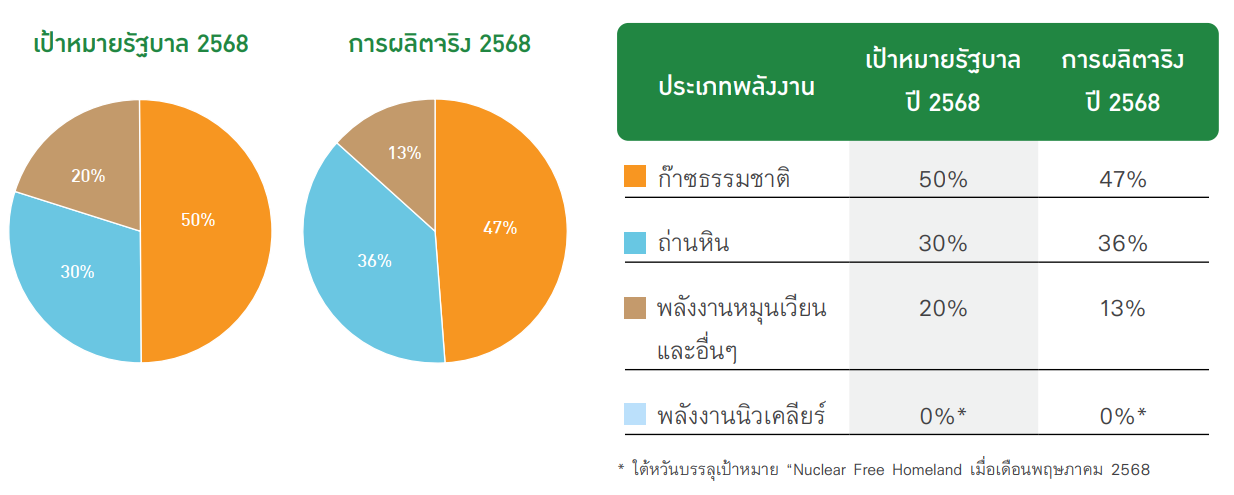
- | Marketing and Competition in Taiwan Electricity Industry Structure in Taiwan The electricity industry structure in Taiwan includes Taipower, which is wholly owned by the Government of Taiwan. Taipower is responsible for purchasing electricity from power producers, managing the transmission system, and distributing electricity to end users. The Government of Taiwan has achieved its Nuclear-Free Homeland policy by successfully phasing out nuclear power generation in 2025. The comparison between the government’s target generation mix and the actual generation mix is as follows:
With reference to 2025 data, the installed electricity generation capacity by energy source is as follows:
Trends in the Renewable Electricity Industry in Taiwan The renewable electricity industry in Taiwan continues to demonstrate strong growth momentum. Under the national energy policy, the Government has established phased renewable energy targets aimed at achieving carbon neutrality (Net-Zero Emissions) by 2050. In the near term, by 2025, the Government targets renewable energy to account for approximately 20.00% of total electricity generation nationwide, with installed capacity of 20 gigawatts of solar power and 5.6 gigawatts of offshore wind power. However, due to land constraints, permitting processes, and grid limitations, certain installations have been deferred to subsequent periods. By 2030, the targets are significantly increased, with solar capacity expected to reach approximately 30 gigawatts and offshore wind capacity approximately 13–14 gigawatts. These targets are supported by investments in energy storage systems and smart grid infrastructure to accommodate a higher penetration of renewable energy. In the long term, by 2050, Taiwan aims for renewable energy to account for 60.00%–70.00% of total electricity generation and to achieve net zero emissions. This transition will be driven primarily by the expansion of solar power, offshore wind power, energy storage systems, and energy efficiency measures as core pillars of the national energy system. During 2024–2025, electricity generation in Taiwan continued to grow, particularly from renewable sources. This growth has contributed to reducing reliance on imported energy and strengthening national energy security. The Government continues to support renewable energy investment through the Feed-in Tariff (FiT) scheme, with tariff rates adjusted annually based on economic conditions and project costs. For 2025, the FiT rates for solar power projects range from approximately TWD 3.50–5.70 per kilowatt-hour, depending on project size and installation type. Onshore wind projects with capacity below 30 kilowatts have a FiT rate of TWD 7.411 per kilowatt-hour, while onshore wind projects with capacity of 30 kilowatts or more have a rate of TWD 2.1286 per kilowatt-hour. Offshore wind projects have a FiT rate of TWD 4.5085 per kilowatt-hour. These rates reflect the Government’s continued commitment to promoting clean energy development in a sustainable manner. The Government of Taiwan also permits renewable energy producers to enter into Corporate Power Purchase Agreements (CPPA) directly with private sector consumers to support corporate demand for clean energy and diversify market mechanisms beyond the FiT system. Electricity supplied under CPPA has continued to grow. In 2024, green energy supplied through CPPA reached 2.49 terawatt-hours, representing an increase of more than 30.00% compared to the previous year. This indicates a significant rise in private sector demand for renewable energy and provides producers with opportunities to achieve higher returns than under the state FiT scheme, representing an important business opportunity for the Group. Furthermore, the Government has revised the relevant regulations to enhance flexibility and facilitate access to the CPPA market for both producers and buyers, resulting in a more open and rapidly growing clean energy market in Taiwan. | ||||||||||||||||||||||||||||||||||||||||||||||||||||||||||||||||||||||||||||||||||||||
- | Marketing and Competition in the Philippines Electricity Industry Structure in the Philippines The electricity industry structure in the Philippines differs from that of neighboring countries in the region, as the energy market has been reformed from a monopoly system to a liberalized and competitive market. In the wholesale electricity market, transactions are conducted through both private power purchase agreements (Private PPAs) and the Wholesale Electricity Spot Market (WESM). Trends in the Renewable Electricity Industry in the Philippines In 2008, the Philippines enacted the Renewable Energy Act of 2008 (RE Act) to establish a policy framework to promote electricity generation from renewable energy sources. The key measures include net metering, which allows electricity consumers to become electricity producers (prosumers); feed-in tariff (FiT), which provides fixed tariff rates for renewable energy electricity throughout the contract period; Renewable Portfolio Standards (RPS), which require an increasing proportion of electricity generation from renewable sources at a rate of 1 percent per year during 2018–2022 and 2.52 percent per year from 2023 onwards; the Green Energy Option Program (GEOP), which allows electricity consumers to choose electricity generated from renewable energy sources; and the Renewable Energy Market (REM), which supports the trading of Renewable Energy Certificates as part of the RPS mechanism. The Government of the Philippines has set a target for electricity generated from renewable energy to account for 35 percent by 2030 and 50 percent by 2040. Accordingly, the National Renewable Energy Program 2020–2040 (NREP 2020–2040) has been issued, setting capacity targets for renewable electricity generation by source as follows:
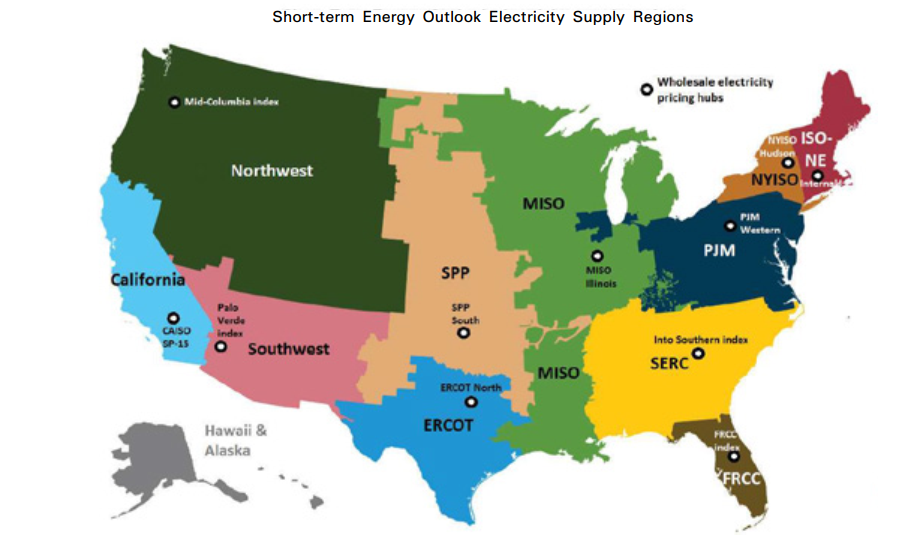
Such developments reflect the commitment to significantly increasing clean energy capacity. At the same time, the integration of energy storage systems has begun to emerge as an important technology to enhance grid flexibility and support peak electricity demand. Marketing and Competition in the United States Electricity Industry Structure in the United States Electricity trading in each region of the United States differs depending on the market structure. It consists of (1) the Wholesale Market, which involves the buying and selling of electricity between power producers and retailers, and (2) the Retail Market, which involves the direct sale of electricity to end consumers. In the Wholesale Market, Regional Transmission Organizations (RTOs) and Independent System Operators (ISOs) are responsible for operating the transmission system and administering electricity trading. Currently, there are 10 RTOs/ISOs as follows:
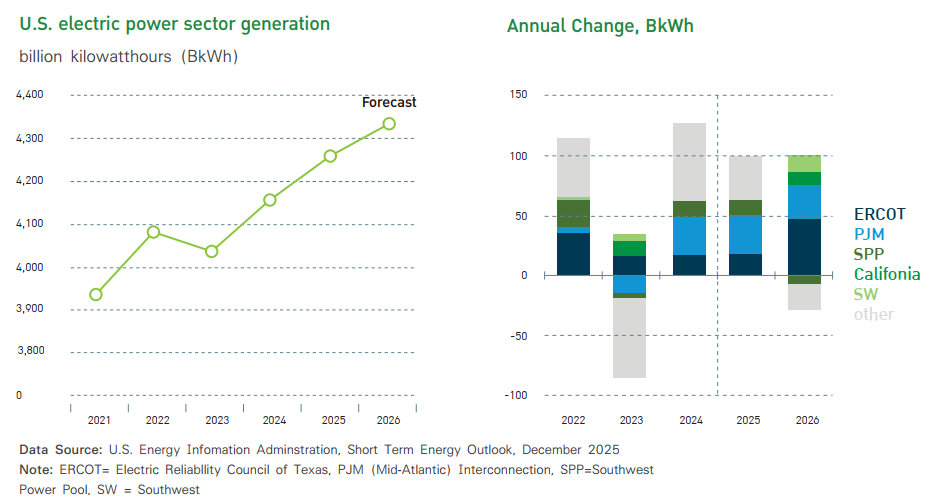
Trends in the Electricity Generation Industry in the United States Electricity generation in the United States has shown an upward trend in recent years after remaining relatively flat for approximately a decade. Between 2010 and 2020, U.S. electricity generation declined at an average rate of 0.3 % per year. However, since 2021, electricity generation has grown at an average rate of approximately 2 % per year. The U.S. Energy Information Administration (EIA) forecasts that U.S. electricity generation will increase by 2.4 % in 2025 and 1.7 % in 2026. Recent growth has largely been driven by rising electricity demand from data centers and large customers in Texas, where the power system is operated by ERCOT, and in the Mid-Atlantic/Ohio Valley region, which is administered by PJM Interconnection. The EIA projects that electricity demand in the PJM region will expand by 3.3 % during 2025–2026, while demand in ERCOT is expected to increase by 5.0 % in 2025 and 9.6 % in 2026. The EIA has revised downward its previous forecast for ERCOT from 6.0 % and 15.7 %, respectively, due to actual large-load electricity consumption in the current year being lower than previously expected.
Changes in Energy Source Structure Natural gas remains the primary energy source in both PJM and ERCOT, with an expected growth rate of approximately 2% during 2024–2026. For PJM, the increase in electricity demand is expected to be met through additional generation from coal and solar power, which are projected to expand by 23% and 63%, respectively, over the same period. In ERCOT, solar power is considered the fastest-growing energy source, with projected growth of 92% during 2024–2026.
In 2024, the United States had a total net summer capacity of 1,230,416 MW, representing an increase of 4% from 2023. The capacity by technology is as follows:
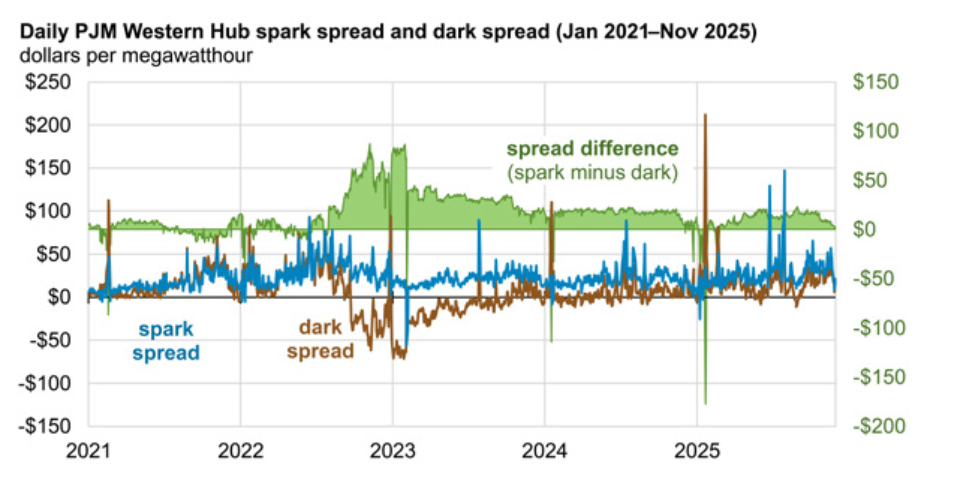
Sources : US Energy Information Administration (eia), State Electricity Profiles In 2024, solar power recorded significant growth of 34%, while coal usage declined by 2%, as a result of government policies promoting renewable energy. In 2024, average wholesale electricity prices in the United States declined from the previous year, and volatility decreased in several regions. The main contributing factors were unusually low natural gas prices during the early part of the year, an increased share of low-cost renewable electricity generation, and the use of energy storage systems, which helped moderate prices during periods of high demand. Although unusually cold weather in certain areas led to short-term price spikes in January, overall prices for the year remained lower compared to 2022–2023. In 2025, electricity prices are expected to increase slightly during certain periods. The EIA projects that the average Henry Hub natural gas price will increase significantly from approximately USD 2.5 in 2024 to USD 3.4 in 2025, representing an increase of around 36%. This increase is expected to be reflected in the fuel costs of gas-fired power plants. In addition, no new coal- or nuclear-fired capacity was added in 2024, which would otherwise have contributed to price stabilization. As a result, average wholesale electricity prices are expected to trend higher than in 2024, particularly in regions that rely heavily on natural gas. During January to November 2025, average daily wholesale electricity prices in the PJM market were higher than in the same period of 2024, enhancing the competitiveness of natural gas- and coal-fired power plants. Key indicators such as the Spark Spread (for natural gas) and the Dark Spread (for coal) are used to assess profitability relative to fuel costs. Both indicators have shown a continuous upward trend over the past two years. Dark Spread (Coal):
Spark Spread (Natural Gas):
This trend indicates that the Dark Spread increased at a faster rate than the Spark Spread, improving the competitiveness of coal-fired power plants relative to natural gas-fired power plants since 2023 onward. Data source: U.S. Energy Information Administration, based on data from S&P Global Market Intelligence. Reference: • U.S. wholesale electricity prices were lower and less volatile in 2024 - U.S. Energy Information Administration (EIA) • Electric generators plan more natural gas-fired capacity after few additions in 2024 - U.S. Energy Information Administration (EIA) • Short-Term Energy Outlook - U.S. Energy Information Administration (EIA) • Electricity Monthly Update - U.S. Energy Information Administration (EIA) • Spark and dark spreads indicate improved profitability of natural gas, coal power plants - U.S. Energy Information Administration (EIA) | ||||||||||||||||||||||||||||||||||||||||||||||||||||||||||||||||||||||||||||||||||||||


Procurement of Products & Services
Reporting Mode
3117
Procurement (Overall)
Electricity Generation Process
Electricity Generation Process of Solar Power Plants
The Group’s existing solar power plants utilize photovoltaic (PV) technology for electricity generation. This process directly converts solar energy into electrical energy through the use of solar cells, also known as photovoltaic cells (PV).
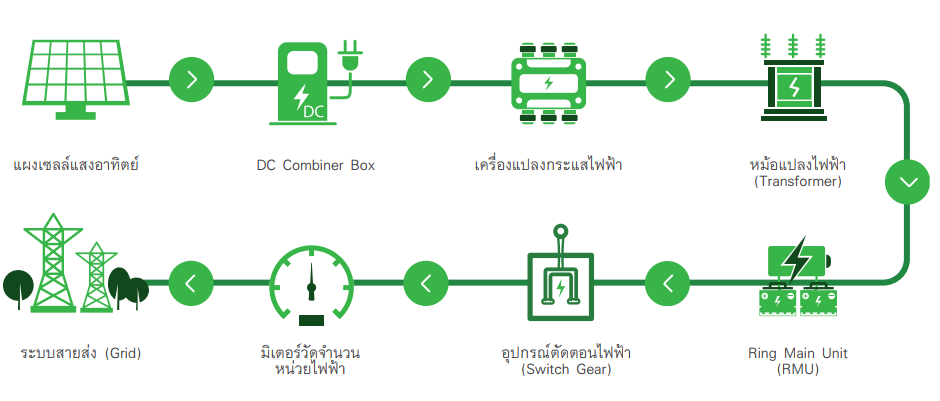
Figure: Electricity Generation Process of Ground-Mounted Solar Power Plants Using Photovoltaic (PV) Technology in Thailand
Electricity Generation Process of Wind Power Plants
The Group’s existing wind power plants generate electricity using onshore wind turbines. The technology applied is a three-blade horizontal axis wind turbine (HAWT). The turbines are equipped with wind direction and wind speed measurement systems to align the rotor with the prevailing wind direction at any given time The main components of the wind turbine include the blades, which are connected to the generator bearing, as well as the electricity generation control system. The electricity generation process is as follows:
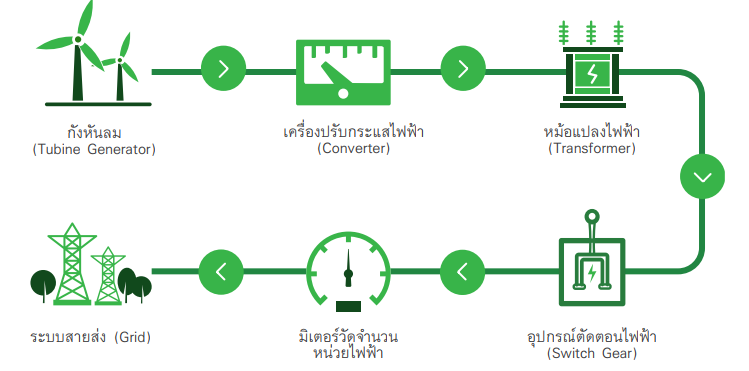
Figure: Wind Power Generation Process Using Horizontal Axis Wind Turbine (HAWT) Technology
Electricity Generation Process of Hydropower Plants
The Group’s existing hydropower plants are run-of-river type power plants. They utilize concrete gravity dams constructed across the river to raise the water level, thereby increasing the water volume and hydraulic pressure required to drive the turbines and generators located at the downstream powerhouse at a lower elevation. The electricity generation process is as follows:
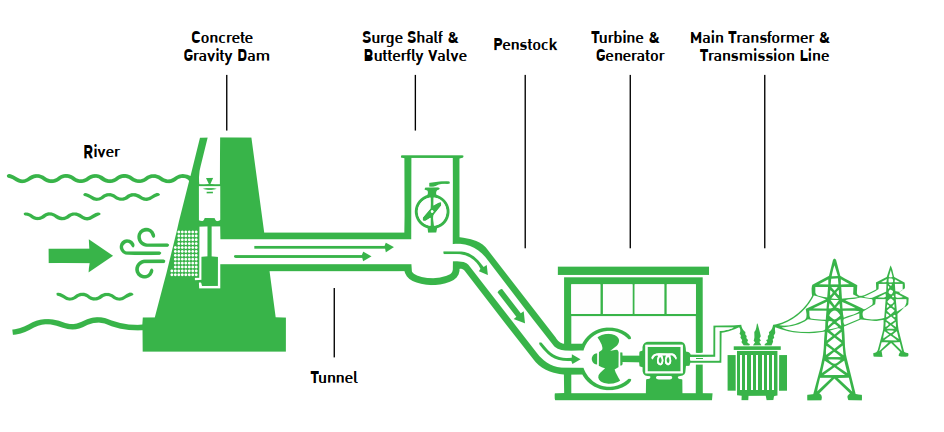
Figure: Electricity Generation Process of Small-Scale Hydropower Project
Raw Material Acquisition (Overall)
Since the Group’s main raw materials consist of solar energy, hydropower, and wind energy, there are no raw material costs in the production process.
Production Policy (Overall)
Installed Capacity and Electricity Generation
As of the end of 2025, the Group had a total contracted capacity of 310.7 megawatts, with commercial electricity sales both domestically and internationally. The electricity generation period by technology is as follows:
Solar power projects operate for approximately 4–5 hours per day, depending on environmental conditions affecting solar irradiance in each location.
Wind and hydropower projects are capable of operating up to 24 hours per day, depending on wind and water availability in each location.
Installed Capacity and Electricity Generated of the Group
2023 | 2024 | 2025 | |
Power Plants in Thailand: | | | 196.7 341.5 |
Power Plants in Japan(1): Electricity Generated (million-kWh) | | | - - |
Power Plants in Lao PDR: Electricity Generated (million-kWh) | | | 114.0 579.5 |
Total Electricity Generated (million-kWh) | | | 310.7 921.0 |
Note (1): The Group disposed of all its solar power plant projects in Japan in June 2024.
Production Capacity (Overall)
| Item | Unit | Unit (if Other) | Used | Capacity |
|---|---|---|---|---|
| - | Others | MW | 0 | 0 |
Domestic/Overseas Purchase Proportion (Overall)
| Raw Material | Source Country | Value |
|---|---|---|
| - | Thailand | 0 |
Product Information — Overview
Introduction
1. Power Plant Projects in Thailand
1.1 Solar Power Plant Projects with a total contracted power generation capacity of 171.1 MW (total installed capacity of approximately 225.1 MW), comprising
Solar power plant projects operated by the Company, with a total contracted power generation capacity of 38.0 MW, a power purchase agreement (PPA) term of approximately 25 years, and an electricity tariff structure consisting of the base electricity tariff (Base Tariff + Fuel Adjustment Charge (Ft)), plus an adder of THB 8.0 per kilowatt-hour (kWh) for 10 years. The Adder for such projects expired in 2022.
Solar power plant projects operated by subsidiaries in which the Company holds 100.0% shareholding (both directly and indirectly), namely BSE, BSE-BRM, BSE-BRM1, BSE-CPM1, BSE-NMA, BSE-PRI, BSP-KAN, BSP-KAN-1, and BSP-LOP, with a total contracted power capacity of 95.0 MW, a PPA term of approximately 25 years, and an electricity tariff structure comprising the base electricity tariff (Base Tariff + Ft), plus an adder of THB 8.0 per kWh for 10 years. The Adder for such projects gradually expired during 2022–2024.
Ground-mounted solar power projects for agricultural cooperatives, supported through BSE-PRI, a subsidiary in which the Company holds 100.0% shareholding, comprising three projects, together with a solar power plant project of BSP-CPRS, with a total contracted power capacity of 17.0 MW, a PPA term of 25 years, and an electricity tariff under Feed-in Tariff (FiT) of THB 5.66 per kWh.
Ground-mounted solar power projects for government agencies and agricultural cooperatives (Phase 2), supported in cooperation with The War Veterans Organization of Thailand Under Royal Patronage of His Majesty the King, comprising five projects, with a total contracted power capacity of 16.9 MW, a PPA term of 25 years, and an electricity tariff under Feed-in Tariff (FiT) of THB 4.12 per kWh.
Floating and ground-mounted solar power plant projects for electricity sales to the private sector, operated by the Company, with a contracted power capacity of 4.2 MW, a PPA term of 25 years, and an electricity tariff equal to Base Tariff + Ft with a discount.
1.2 Wind Power Plant Project in Pak Phanang District, Nakhon Si Thammarat Province, with a contracted power capacity of 9.0 MW, a PPA term of approximately 25 years, and an electricity tariff structure comprising the base electricity tariff (Base Tariff + Ft), plus an adder of THB 3.50 per kWh for 10 years.
1.3 Solar Rooftop Projects that the Company entered into PPAs with both the public and private sectors, with contract terms ranging from 15–25 years, with a total installed capacity of 33.3 MW and commercial operation of 16.6 MW, and an electricity tariff based on Base Tariff + Ft with a discount.
2. Power Plant Projects in the Lao PDR
2.1 Two hydropower plant projects in the Lao PDR with a total contracted capacity of 114.0 MW, a PPA term of 25 years from the date of the first meter reading for electricity sales, and an average electricity tariff of USD 0.0695 per kWh. Both projects are operated by Nam San 3A Sole Co., Ltd. and Nam San 3B Sole Co., Ltd.
In addition, BCPG Indochina Co., Ltd. (“BIC”), a subsidiary in which the Company holds a 100.00% shareholding, invested in the Nam Tai hydropower project in the Lao PDR to obtain 50.00% economic rights in the 220 kV transmission line and substation of the Nam Tai project, which are connected to the EVN transmission system, as well as the right to manage electricity sales from nearby renewable power projects.
2.2 A wind power plant project in the Lao PDR (the Monsoon Project), indirectly invested in through an associate (IEAD), located in Sekong Province and Attapeu Province, with a contracted capacity of 600 MW, or attributable generation capacity of 289.5 MW based on the investment proportion, generates and sells electricity via a 500 kV transmission line to Da Nang, Viet Nam, with a PPA term of 25 years from the commercial operation date. The project commenced commercial operation for Zones 1 and 2 on 17 July 2025, and for Zones 3 and 4 on 22 August 2025.
3. Power Plant Projects in the Republic of China (Taiwan)
In November 2021, the Company established BCPG Formosa Co., Ltd. in the Republic of China (Taiwan) as a wholly owned subsidiary, with the objective of investing in and developing renewable power plant projects. The Group plans to develop solar power plant projects with a revised development target of 234 MW and a PPA term of 20 years from the commercial operation date. Currently, these projects are in the process of applying for power generation business licenses and construction permits. Furthermore, there is a planned pipeline with a future capacity of 235 MW. Upon the completion, the total capacity of these projects will reach 469 MW.
4. Infrastructure Business
Asia Link Terminal Co., Ltd. operates an oil storage terminal and port facilities in Phetchaburi Province on an area of approximately 150 rai. The project is an energy-related public utility infrastructure with potential to be further developed to support other related businesses, in line with the Company’s strategic plan to seek investment opportunities in businesses related to the energy industry and public utility systems.
Projects Under Construction
Has Projects Under Construction (Y/N)
Yes
Introduction
As at 31 December 2025, the Company had uncompleted project with a total value of 13.01 million Baht, and one subsidiary had an uncompleted project with a total value of 291.27 million Baht.
Description
-
Total Projects
2
Total Project Value
435.99
Recognized Value
304.28
Remaining / Unrecognized Value
131.71
Projects
| Project Name | Value | Income % | Est. Years | Est. Months | Est. Completion |
|---|---|---|---|---|---|
| Solar rooftop projects at Bangchak Gas Station | 90 | 0 | 0 | 10 | 2026-10-01 |
| Installing and managing district cooling system project | 345 | 0 | 2 | 9 | 2026-03-01 |
Debentures & Bills of Exchange
Introduction
On 30 October 2025, TRIS Rating affirmed the Company’s corporate credit rating and the ratings of its senior unsecured debentures at “A”, with a “Stable” outlook.
As of 31 December 2025, the Company had outstanding debentures totaling 19,044 million Baht. In 2025, the Company did not issue any debt securities.
Has Debentures (Y/N)
Yes
Debentures
| Debenture Name | Interest Rate (%) | Outstanding | Maturity Date | Term | Types |
|---|---|---|---|---|---|
| GREEN DEBENTURES OF BCPG PUBLIC COMPANY LIMITED NO. 1/2564 TRANCHE 2 DUE B.E. 2569 (BCPG269A) | 2.14 | 1,000 | 15 September 2026 | 5 | 2789 · Description: Senior Debenture · 2791 · Description: Unsecured Debenture |
| GREEN DEBENTURES OF BCPG PUBLIC COMPANY LIMITED NO. 1/2564 TRANCHE 3 DUE B.E. 2571 (BCPG289A) | 2.51 | 1,000 | 15 September 2028 | 7.01 | 2789 · Description: Senior Debenture · 2791 · Description: Unsecured Debenture |
| GREEN DEBENTURES OF BCPG PUBLIC COMPANY LIMITED NO. 1/2564 TRANCHE 4 DUE B.E. 2574 (BCPG319A) | 3.31 | 4,000 | 15 September 2031 | 10.01 | 2789 · Description: Senior Debenture · 2791 · Description: Unsecured Debenture |
| GREEN DEBENTURES OF BCPG PUBLIC COMPANY LIMITED NO. 1/2564 TRANCHE 5 DUE B.E. 2576 (BCPG339A) | 3.61 | 4,000 | 15 September 2033 | 12.01 | 2789 · Description: Senior Debenture · 2791 · Description: Unsecured Debenture |
| DEBENTURES OF BCPG PUBLIC COMPANY LIMITED NO. 1/2566 TRANCHE 2 DUE B.E. 2569 (BCPG266A) | 3.37 | 1,612.5 | 29 June 2026 | 3 | 2789 · Description: Senior Debenture · 2791 · Description: Unsecured Debenture |
| DEBENTURES OF BCPG PUBLIC COMPANY LIMITED NO. 1/2566 TRANCHE 3 DUE B.E. 2570 (BCPG276A) | 3.67 | 2,253.4 | 29 June 2027 | 4 | 2789 · Description: Senior Debenture · 2791 · Description: Unsecured Debenture |
| DEBENTURES OF BCPG PUBLIC COMPANY LIMITED NO. 1/2566 TRANCHE 4 DUE B.E. 2575 (BCPG326A) | 4.07 | 353.6 | 29 June 2032 | 9.01 | 2789 · Description: Senior Debenture · 2791 · Description: Unsecured Debenture |
| DEBENTURES OF BCPG PUBLIC COMPANY LIMITED NO. 1/2566 TRANCHE 5 DUE B.E. 2578 (BCPG356A) | 4.33 | 2,825 | 29 June 2035 | 12.01 | 2789 · Description: Senior Debenture · 2791 · Description: Unsecured Debenture |
| DEBENTURES OF BCPG PUBLIC COMPANY LIMITED NO. 1/2024 SERIES 1 DUE B.E. 2570 (BCPG276B) | 3.25 | 1,200 | 26 June 2027 | 3 | 2789 · Description: Senior Debenture · 2791 · Description: Unsecured Debenture |
| DEBENTURES OF BCPG PUBLIC COMPANY LIMITED NO. 1/2024 SERIES 2 DUE B.E. 2572 (BCPG296A) | 3.69 | 800 | 26 June 2029 | 5 | 2789 · Description: Senior Debenture · 2791 · Description: Unsecured Debenture |
Convertible Securities
Has Convertible Securities (Y/N)
Yes
Convertible Securities
| Security Name | Issued Date | Exercise Date(s) | Maturity Date | Exercise Price | Exercise Ratio | Allotted Shares | Convertible Shares | Unconverted Shares | Remaining Convertible | Notification Period | Description |
|---|---|---|---|---|---|---|---|---|---|---|---|
| Warrants to purchase common shares of BCPG Pcl. specifically offered to directors, executives and employees of the Company and its subsidiaries No. 2 (BCPG ESOP-WS#2). | 2021-04-24 | Every 20th of January, April, July and October throughout the Term of Warrant. The first Exercise Date is April, 20 2023 and the Last Exercise Date during the 5 Business Days before the Date on the Warrant 5 years from the Company of their intention to exercise Warrant. | 2026-04-24 | 15.89 | 20000000.000:20000000.000 | 0 | 0 | 20,000,000 | 20,000,000 | The BCPG ESOP-WS #2 Holders who wish to exercise the right to purchase the ordinary shares of the Company shall declare the intention to exercise the right between 09.00 - 15.00 hrs. prior to each Exercise Date at least five business days in advance. With the exception of the last Exercise Date. | The exercise price of 15.89 Baht per share is the average price calculated from the following price ranges:
1. 13.70 Baht per share for 25% of the total BCPG ESOP-WS#2 warrants to be issued and offered.
2. 15.07 Baht per share for 25% of the total BCPG ESOP-WS#2 warrants to be issued and offered.
3. 16.58 Baht per share for 25% of the total BCPG ESOP-WS#2 warrants to be issued and offered.
4. 18.23 Baht per share for 25% of the total BCPG ESOP-WS#2 warrants to be issued and offered. |